
There has been a noticeable shift in the conversation surrounding tap water in the UK. Once considered safe, regulated and perfectly drinkable, reports of microplastics, heavy metals and even hormone-disrupting chemicals in our supplies have sparked concern. But what does it really mean for our health?
It’s easy to feel torn. Is this just wellness scaremongering, or should we be rethinking what comes out of the kitchen tap?
To cut through the noise, we spoke to the experts to understand what’s actually in our water, how it might interact with our health, and what practical steps (and filters) are worth considering.
What’s really in our tap water (and why it matters)
Most of us assume the water flowing from our taps is clean and safe – and in the UK it is tightly regulated to prevent harmful levels of known toxins. But that doesn’t mean it’s completely free of other substances.
Recent research shows that trace amounts of microplastics, heavy metals, pharmaceutical residues and pesticides are present in many domestic water supplies. While these aren’t present at acutely toxic levels, the long-term effects of tiny, repeated exposures may be cause for concern.
“As a naturopath and herbalist, I’m often asked whether concerns about hidden contaminants are legitimate,” says Jenya Di Pierro, founder of wellness club, Cloud Twelve. “The truth is, growing evidence confirms that contaminants are indeed present in our water systems, and it’s not simply speculation.”
So, what’s in our tap water exactly?
- Microplastics: These tiny plastic fragments are sadly now found in food, air, and drinking water. A recent UK study detected them in every tap water sample tested, ranging from 6 to 100 microplastic particles per litre, and even in bottled water, including glass bottles with plastic-lined caps.
- Heavy metals: Trace levels of lead, nickel, arsenic and cadmium can appear in drinking water, which even at very low concentrations, can accumulate in our bodies over time.
- Pharmaceuticals and personal care products (PPCP): Think antibiotics, prescription drugs, and non-prescription drugs. When it comes to hormone health, Jenya points out that PPCPs are the most concerning. “A number of them can act as endocrine disruptors, which interfere with the functions of hormonal systems,” she explains.
- “Forever chemicals” (PFAS): Found in food packaging, cosmetics and industrial processes, many PFAS have now been banned, but they’re persistent enough to remain in the environment (and our tap water). According to the UK Drinking Water Inspectorate, low-level PFAS have been detected in some water sources, though 2024 testing found that no tap water exceeded the highest risk threshold.
- Pesticides: Washed from fields into rivers and groundwater, pesticides are removed from our tap water via treatment plants, but traces can remain. One study found 11 pesticides present in the water tested.
It’s a sobering list, but context matters. These aren’t reasons to fear every glass of tap water – rather, they highlight a growing awareness that water isn’t just plain and simple H₂O.
Why women in midlife may be more vulnerable
We all know that perimenopause and menopause are times of huge hormonal change. Falling levels of oestrogen can make the body more sensitive to hormone-like compounds – known as endocrine disruptors – which can mimic or interfere with our own hormones.
“Even at very low levels, these compounds can disrupt the endocrine system,” Jenya warns.
For women already navigating fluctuating hormones, this extra load can add unnecessary stress.
To filter or not to filter?
Reading about microplastics, pesticides and hormone disruptors can feel unsettling. It’s worth remembering that UK tap water is carefully regulated and not considered dangerous to drink. Staying well hydrated still does far more good than harm.
That said, if you’re keen to reduce your exposure to trace contaminants, using a good filter can help. Think of it less as panic-buying insurance and more as an extra layer of support for long-term health.
“For me, investing in a high-quality filter is one of the most powerful things you can do,” Jenya says.
Which water filter is best?
Not all water filters are made equal. They can differ in their mechanism and price point, so learning the basics is key.
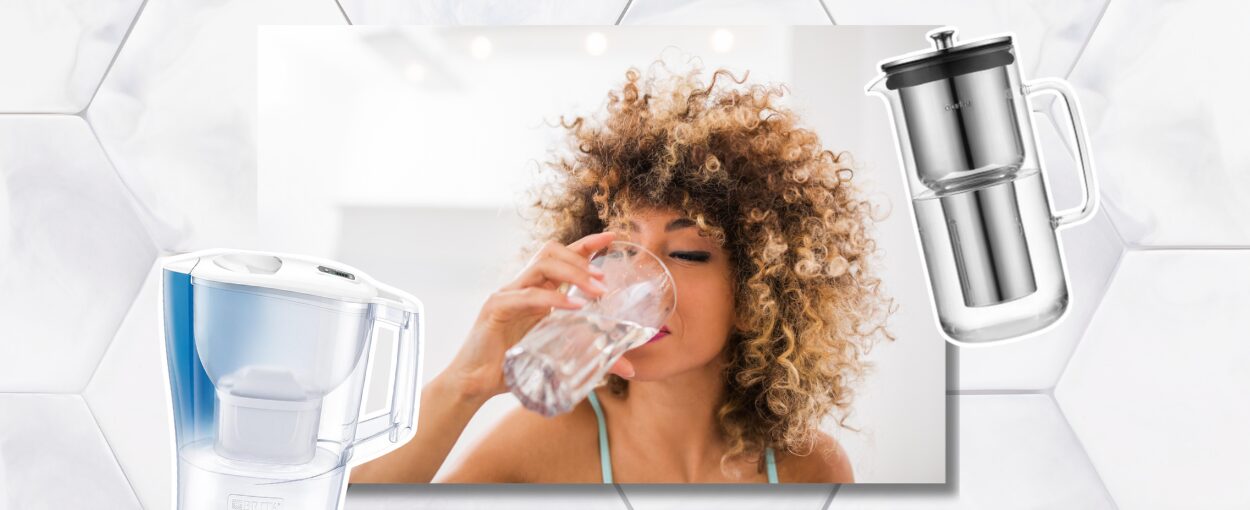
- Jug filters: Affordable and easy to use. They mainly improve taste and reduce chlorine but won’t reliably remove hormones, pharmaceuticals or heavy metals.
- Countertop or under-sink carbon block filters: A step up from jugs. They can reduce chlorine, some metals and some pesticides.
- Carbon + ion exchange systems: Often found in higher-end jugs or built-in taps, these are better at reducing certain heavy metals (like lead) but still limited against pharmaceutical residues or hormone disruptors.
- Multi-stage under-sink systems: Combine several technologies (carbon, ion exchange, sometimes UV or additional membranes) to cover a wider range of contaminants; a good mid-range step.
- Reverse osmosis (RO) systems: The gold standard for home use. They remove up to 99.99% of most contaminants, including microplastics, hormone disruptors and many pharmaceuticals.
- Glass-bottled spring water: A practical alternative if you can’t install a filter, though less eco-friendly and more expensive long-term.
Jenya’s go-to is a reverse osmosis (RO) system. “When selecting a unit, remember that the more filtration stages, the better,” she advises. “Each stage is designed to target a different category of contaminant, so a multi-layer system, like RO filters, will give you the cleanest possible water.”
But RO filters can come with a hefty price tag. Other water filters can still offer plenty of benefits, too.
“Standard jugs are still good for removing chlorine and some heavy metals,” says Helena Barham-Coppola, a functional medical practitioner. “I’m also a fan of under-sink filters. They’re more affordable than RO filters, and will remove many (but not all) heavy metals, plastics, and chlorine.”
The takeaway
UK tap water is safe to drink. Staying hydrated will always do far more for our health than avoiding the tap out of fear. But if you do want to reduce your everyday exposure to hormone-disrupting chemicals, microplastics and other trace contaminants, choosing a good filter can be a smart upgrade.
Ultimately, it’s about balance: supporting our health without panic or perfectionism.