
Is a low-fat diet really the best choice for women looking to manage their weight and cholesterol in midlife? Liz explains why she prefers whole, naturally satisfying foods over many low-fat alternatives, which can contain added sugars and fillers to replace lost flavour. She also explores the role of healthy fats and how to make more informed choices to support a healthy metabolism.
Plus: Advice for skin pigmentation, supporting your skin and body when oestrogen isn’t an option, why cholesterol isn’t the bad guy and has my HRT stopped working?
Stream the episode below, or download the recording via Apple Podcasts or Spotify.
Are low-fat foods really the healthier choice?
If you’ve been reaching for low-fat alternatives in an effort to look after your waistline or keep your cholesterol in check, you might want to think again. While fat has long been seen as something to avoid in our diets, it’s not quite the enemy we once thought it was.
As Liz explains, our bodies actually need fats (and cholesterol) to function optimally. By cutting it out completely we may be unintentionally adding all sorts of unnecessary additives, which is why it’s important to look beyond the fat content on the label.
What happens when the fat is taken out
One of Liz’s main reservations about low-fat foods is what happens when fat is taken out. Fat helps give food its flavour and satisfying texture, so manufacturers may add other ingredients to compensate.
“Very often, what they do is they take the fat out and they put something else in to make it taste nice,” she explains. This can mean added sugar, fillers or other additives. Lower-fat foods may also provide fewer fat-soluble vitamins, while being less satiating on the whole, leaving you hungrier quicker.
Our fear of fat has also moved us away from home-cooked whole foods as we reach for processed low-fat alternatives. But as Liz highlights, a reduced-fat label doesn’t automatically make something a healthier choice, and she prefers whole foods in their more natural form.
Not all fats are created equal
There are certainly some fats that are worth avoiding. Trans fats, for instance, are chemically altered vegetable oils added to preserve food for longer, and have a proven negative impact on our health. These fats can be found in cakes, biscuits, pastries and margarines.
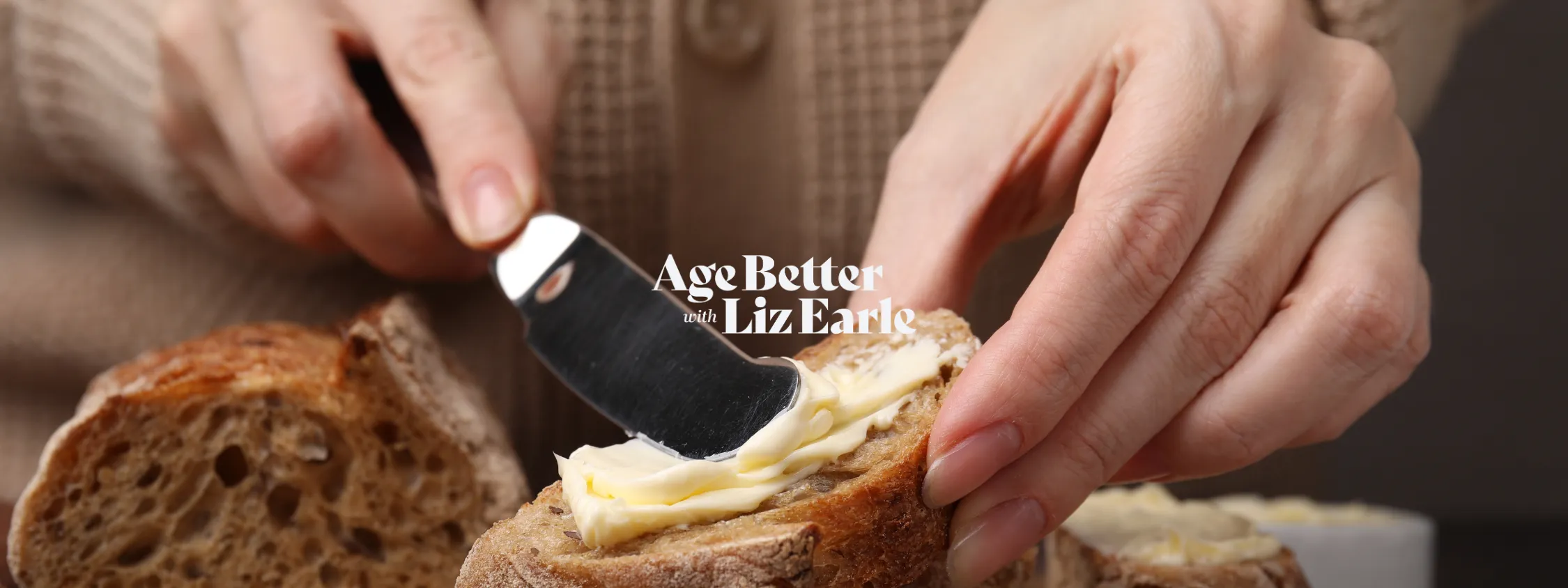
Liz always chooses grass-fed butter over ultra-processed spreads, and makes her own version by mixing equal parts butter and olive oil. It’s soft enough to spread straight from the fridge and reduces the amount of saturated fat compared with using butter alone.
But some fats are beneficial for supporting heart health and cognitive function and reducing inflammation, such as omega-3 fats, found primarily in oily fish. We should aim to eat oily fish such as mackerel or salmon twice a week, or look for a good-quality omega-3 supplement.
Keep it balanced
The important thing is to never dismiss foods outright without reading the labels. As Liz points out, while she wouldn’t reach for low-fat foods in theory, reduced-fat Greek yoghurt can still be an excellent option for its healthy protein content.
And while full-fat foods can be more satisfying, it’s not a licence to eat unlimited amounts – portion sizes still matter. It’s about enjoying a balanced diet and being sensible with quantities, without obsessing over calories or dividing all foods into ‘good’ and ‘bad’.
Read 0%, 5% or 10% Greek yoghurt – which is healthiest?
Also in this episode:
- Explaining cholesterol: the difference between LDL and HDL
- How changing hormones impact cholesterol and weight
- Why our body and brain need cholesterol
- What’s causing my skin pigmentation?
- How menopause changes where we store fat
- Does testosterone help a flagging libido?
- How to support your body and skin health when you can’t take oestrogen
- Can HRT stop working?
Links mentioned in this episode:
- HRT lottery website
- Dr Louise Newson
- Instagram live with Laura Dowling on cholesterol, heart health, bones and muscles
- Use code LIZLOVES to save 15% on fabÜ Shrooms Cholesterol & Heart supplement
- Podcast with Zoe Harcombe on saturated fat and cholesterol
- Skin Diligent Vitamin C Serum-in-Oil – save 15%
- Randox health tests
- Article on vaginal oestrogen and Intrarosa
- By Sarah Hero Facial Oil – save 20%
Get in touch with a question for Liz:
- Email: [email protected]
- WhatsApp: 07518 471 846
More from Liz:
Some links may be affiliate links, which help support the show at no extra cost to you. Read our Affiliate Policy for more information.